In today’s rapidly changing education landscape, School Leadership is no longer just about managing timetables, discipline, and academics. The most effective School Principals are now expected to think strategically, inspire teams, improve outcomes, build strong culture, and ensure long-term institutional growth. Interestingly, many of the leadership practices used by successful corporate CEOs can offer valuable lessons for school heads.
For institutions aiming to grow, innovate, and remain relevant, there is much to learn from the corporate world. At Alert Knowledge Services, we believe that modern educational institutions thrive when leadership combines vision, systems, accountability, and people development.
Vision Must Be Clear and Communicated Repeatedly
Successful CEOs are known for building organizations around a strong and compelling vision. They do not keep the vision limited to boardrooms or annual reports. They communicate it consistently until every employee understands it and works toward it.
The same principle applies to School Leadership. A school principal must clearly define what the school stands for. Is the school focused on academic excellence, holistic development, innovation, discipline, or future-readiness? Once that vision is defined, it must be communicated to teachers, students, parents, and staff at every level.
Strong School Principals do not simply run schools; they shape direction. When the school community understands the vision, alignment improves, decision-making becomes easier, and collective effort becomes more meaningful.
Systems Matter More Than Individual Effort
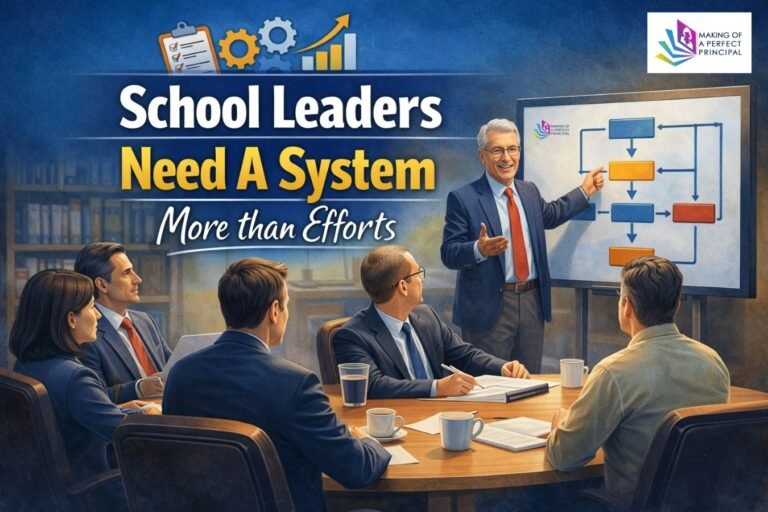
One of the greatest lessons corporate CEOs teach is that organizations do not grow on passion alone. They grow on systems. Even the most talented team cannot succeed for long without structured processes, accountability, and measurable goals.
This is especially relevant in education. Many schools depend too heavily on the personal effort of a few committed individuals. But sustainable improvement happens when principals create systems for academic planning, teacher evaluation, student support, parent communication, and performance tracking.
This is where effective School Leadership becomes transformational. A principal who builds systems ensures that quality does not depend on mood, memory, or individual effort alone. At Alert Knowledge Services, we emphasize this principle because strong systems help schools scale excellence with consistency.
Data Should Drive Decisions
Corporate CEOs rarely make important decisions based only on assumptions. They study data, trends, performance reports, customer feedback, and financial indicators before taking action.
Likewise, modern School Principals should embrace data-driven leadership. Attendance records, academic performance, assessment patterns, teacher productivity, parent feedback, and student behaviour trends can all provide valuable insights. Data helps principals identify problems early, measure progress, and make informed interventions.
For example, if student performance in a specific subject is declining, data can help uncover whether the issue is linked to teaching methods, curriculum gaps, attendance, or assessment design. Smart School Leadership uses evidence, not guesswork, to improve outcomes.
Great Leaders Build Great Teams
A CEO’s success is never a solo achievement. It depends on hiring the right people, developing talent, and building a strong leadership pipeline. Corporate leaders invest in their teams because they understand that organizational growth is impossible without people growth.
This lesson is critical for School Principals. A school can only be as strong as its teachers and middle leaders. Principals must identify strengths, mentor teachers, encourage collaboration, and create opportunities for professional development. Schools that invest in teacher capacity create lasting impact in classrooms.
Leadership development within schools is equally important. Department heads, coordinators, and senior teachers should be empowered with responsibility and trained to lead effectively. This distributed leadership model strengthens institutions and reduces overdependence on one individual.
Culture Eats Strategy If Left Ignored
Corporate CEOs understand that workplace culture influences productivity, retention, morale, and innovation. Even the best strategy can fail in a toxic culture.
The same is true in schools. A principal may have ambitious plans, but unless the school culture supports trust, discipline, teamwork, respect, and accountability, those plans may not succeed. School culture shapes how teachers collaborate, how students behave, and how parents perceive the institution.
Effective School Leadership focuses not only on rules and results but also on relationships and culture. Principals who model integrity, empathy, consistency, and professionalism create environments where people feel motivated and valued. A healthy school culture is often the hidden engine behind sustainable school improvement.
Communication Is a Leadership Tool
Top CEOs know that communication is not a soft skill; it is a core leadership function. They communicate expectations clearly, address challenges honestly, and keep stakeholders informed.
For School Principals, communication is equally essential. Teachers need clarity. Parents need reassurance. Students need motivation. Staff need direction. Miscommunication often leads to confusion, resistance, and mistrust.
Principals who communicate with transparency and confidence are better able to lead change, resolve conflict, and build stronger school communities. Whether through meetings, newsletters, workshops, or one-on-one conversations, communication must be regular, purposeful, and aligned with the school’s goals.
Innovation Is No Longer Optional
Corporate CEOs continuously adapt to market shifts, technology, and customer needs. They know that staying still is risky.
Schools face a similar reality. Changes in technology, student expectations, learning methods, and parent aspirations require schools to evolve. School Leadership today must be open to innovation in teaching, assessment, training, and school management.
This does not mean following every trend blindly. It means staying responsive, relevant, and future-focused. Principals should explore new ideas, evaluate what works, and encourage a mindset of continuous improvement. Schools that innovate thoughtfully are better positioned to prepare students for the real world.
Accountability Creates Excellence
Corporate leaders set targets, review progress, and hold teams accountable. Without accountability, even good plans lose momentum.
The same applies in educational institutions. Effective School Principals create accountability structures for teachers, coordinators, and administrative teams. Clear expectations, follow-up reviews, constructive feedback, and performance benchmarks are essential for improvement.
Accountability should not be confused with fear. In strong School Leadership, accountability is paired with support. The goal is not to punish but to strengthen performance and help people succeed. When accountability becomes part of school culture, standards rise naturally.
Stakeholder Trust Is a Strategic Asset
For CEOs, investor trust and customer confidence are vital. Without trust, growth becomes difficult.
For schools, trust among parents, students, staff, and the community is equally important. School Principals must understand that trust is built through consistency, transparency, responsiveness, and quality delivery. Parents want to know their children are safe, valued, and learning effectively. Teachers want leadership they can rely on. Students want fairness and encouragement.
Trust is not built through slogans. It is built through daily leadership actions. Principals who earn trust create stronger school brands and lasting institutional credibility.
Continuous Learning Defines Great Leadership
The best CEOs are lifelong learners. They read, listen, adapt, and keep developing their leadership skills.
This mindset is essential for School Leadership as well. The education sector is evolving quickly, and principals who stop learning risk becoming outdated. Attending workshops, engaging in leadership training, learning from industry practices, and reflecting on one’s own school systems are all important for long-term success.
At Alert Knowledge Services, we strongly advocate continuous learning for educational leaders. When School Principals grow, schools grow. Leadership development is not an optional extra; it is a strategic necessity.
Why This Matters for Modern Schools
The role of the principal has changed significantly. Today’s school leader must act as an academic guide, team builder, strategist, communicator, culture shaper, and operational thinker. This is why lessons from corporate leadership are so relevant.
Corporate CEOs and School Principals work in different sectors, but both are responsible for vision, performance, people, systems, and growth. The best school leaders are those who blend educational values with strong organizational leadership practices.
For schools that want to move from routine administration to transformational growth, the answer lies in leadership that is strategic, structured, and future-ready.